
Quick links
The carnivore diet is one of the most extreme eating trends currently circulating across social media, podcasts and YouTube wellness culture. Built around the idea of eating only animal-based foods, it cuts out almost all plant foods and has sparked plenty of curiosity, debate and strong opinions online.
Part of its popularity comes from the kinds of bold statements that perform well on the internet. Claims such as “I healed everything by eating only steak” or “plants are trying to kill you” are designed to grab attention, but dramatic testimonials are not the same as evidence. As explored by Metro North Health, the diet has gained traction largely because of the way it is discussed online rather than because it is widely supported by mainstream nutrition guidance.
Some people do report short term positives, which is part of what keeps the conversation going. But what trends online is not always what works safely, realistically or sustainably in everyday life. Before committing to a diet this restrictive, it is worth taking a closer look at what it actually involves, why people are drawn to it and what the potential trade-offs may be. In the following article, we take a closer look at the carnivore diet, unpack the claims behind its popularity and explore whether it is truly a healthy and sustainable choice.
If you have been wondering what is the carnivore diet, the answer is quite simple in theory, but much more complicated in practice. The carnivore diet is an eating pattern based almost entirely on animal foods such as meat, fish, eggs and sometimes dairy, while excluding fruits, vegetables, legumes, grains, nuts and seeds.
Some versions are stricter than others. A more rigid carnivore diet plan might include only red meat, salt and water. Other versions allow eggs, butter, cheese and some low-lactose dairy foods. Either way, the defining feature is the near total removal of plant foods.
That simplicity is often presented as a benefit, but it comes from severe restriction rather than balance. As explained by MyDr and Deakin University’s Institute for Physical Activity and Nutrition, this is not a standard medical nutrition plan and it is not broadly recommended by mainstream dietary guidelines.
The Carnivore diet at a glance
Carnivore diet overview |
|---|
Main foods | Primarily animal-based foods such as red meat, poultry, fish, eggs, organ meats and animal fats |
Sometimes included | Some versions also allow butter, cheese and other dairy products |
Excluded foods | All or most plant foods, including fruit, vegetables, grains, legumes, nuts and seeds |
Appeal | Often promoted as simple to follow because it removes food decisions and limits variety |
Key concern | Its highly restrictive nature may reduce dietary balance, variety and nutrient intake |
A typical carnivore diet food list is fairly short. It may include steak, mince, lamb, chicken, bacon, eggs, fish, bone broth, organ meats and, in some versions, butter or cheese. People searching for carnivore diet recipes are usually looking for highly simplified meals because variety is limited by design.
A basic carnivore diet plan might look something like this:
- Breakfast: eggs cooked in butter with bacon
- Lunch: beef mince patties or steak
- Dinner: grilled salmon, lamb chops or roast chicken
- Snacks, if included: boiled eggs, jerky, cheese or bone broth
On the surface, that can feel easy to follow. There is less meal planning, fewer ingredients and fewer decisions to make. But the narrowness of the food list is also one of the biggest concerns. Removing entire food groups means removing fibre, a wide range of vitamins and minerals, and many plant compounds associated with long term health benefits.
As noted by myDr, Deakin University and the World Science Festival Brisbane, simplicity can make a diet feel manageable at first, but that does not automatically make it nutritionally complete.
The carnivore diet owes much of its profile to influencers, podcast hosts and celebrities who describe dramatic personal transformations after trying it. Joe Rogan is one of the best-known public figures associated with experimenting with the diet publicly, and stories like these have helped fuel the perception that carnivore is a shortcut to fat loss, better energy and improved health. As noted by Metro North Health and News-Medical, the diet’s appeal is often tied to distrust of conventional nutrition messaging and the popularity of all-or-nothing health narratives. The Guardian also highlights how extreme diets thrive in a wellness culture that rewards contrarian thinking, dramatic personal testimony and simple explanations for complex health issues.
But influencer experiences are not the same as scientific evidence. Extreme diets spread quickly because they make compelling content. Videos and posts promising rapid weight loss, mental clarity or a total health reset are far more clickable than balanced advice about moderation and long term wellbeing.
A well-known example is Brian Johnson, better known as the “Liver King”, who built a large following by promoting an all-natural ancestral lifestyle centred around raw liver, steak and other animal foods. He presented his physique as proof of what this way of eating could achieve, but later admitted he had been using steroids after previously denying it. A commentary in the International Journal of Drug Policy uses the Liver King case to highlight how undisclosed performance-enhancing drug use can create unrealistic expectations and mislead audiences.
That matters because the carnivore diet is often sold as more than just a way of eating. It is framed as a rejection of mainstream advice and a shortcut to control, clarity and better health. In online spaces that reward certainty and controversy, that message can be very persuasive, even when the evidence is far less convincing than the claims suggest.
The reason that interest in carnivore diet weight loss remains high is that people often do see changes in the short term. This is not unique to carnivore. When someone makes a major dietary shift, especially one that removes many everyday foods, they often end up eating fewer calories overall.
A more limited menu can reduce mindless snacking, cut out many ultra processed foods and create more structure around eating. Those changes can absolutely affect body weight, at least for a while.
But short term weight loss does not necessarily mean a diet is uniquely effective or healthy. As discussed in myDr, News-Medical and this published review on PMC, restrictive diets can produce early results because they make it easier to under-eat temporarily, not because the underlying pattern is superior in the long run.
The harder question is whether those results can be maintained without nutritional, social, emotional or financial downsides. For many people, that is where things become more difficult.
To look at the topic fairly, it is worth acknowledging why some people feel positive about the carnivore diet.
Reported benefits often include:
- reduced cravings
- less reliance on ultra processed foods
- simpler meal decisions
- short term weight loss
- a feeling of more stable energy or blood sugar
- perceived improvements in digestive discomfort or inflammation-related symptoms
There is also interest in whether the diet may affect autoimmune symptoms, pain or energy levels. Some discussions around symptom relief can be found in articles such as St. Pete Arthritis & Rheumatology, and the broader review literature at PMC.
Still, anecdotal reports need to be interpreted carefully. Feeling better after starting the carnivore diet does not automatically mean that removing all plant foods is the reason. Some people may be coming from a lifestyle built around frequent takeaways, high calorie foods, alcohol and low activity, then see results simply because they are eating fewer calories, cutting back on processed food and following a more structured routine.
Those changes can absolutely produce short term improvements. But that does not prove the carnivore diet is uniquely beneficial. In many cases, similar results could also be achieved through a more balanced diet combined with a calorie deficit and healthier overall habits. That distinction matters because early progress is not the same as evidence that the diet is the healthiest or most sustainable long term option.
The biggest criticism of the carnivore diet is that it removes too much. A healthy eating pattern is generally expected to provide sufficient energy, enough protein, dietary fibre, a broad range of vitamins and minerals, and variety across food groups. Carnivore struggles on several of those fronts.
Experts often raise concerns about:
- the complete lack of fibre
- lower intake of vitamin C, folate and other nutrients
- reduced exposure to beneficial plant compounds
- limited support for gut health
- possible impacts on cholesterol and heart health
- digestive issues such as constipation
- poor long term dietary variety
These concerns are outlined by Deakin University, the World Science Festival Brisbane and Metro North Health. The scale of that restriction is easier to see visually. In the guide below, the food groups typically excluded on a carnivore diet are greyed out, while the foods generally included remain in colour.
Figure 1. Food groups typically included and excluded on a carnivore diet
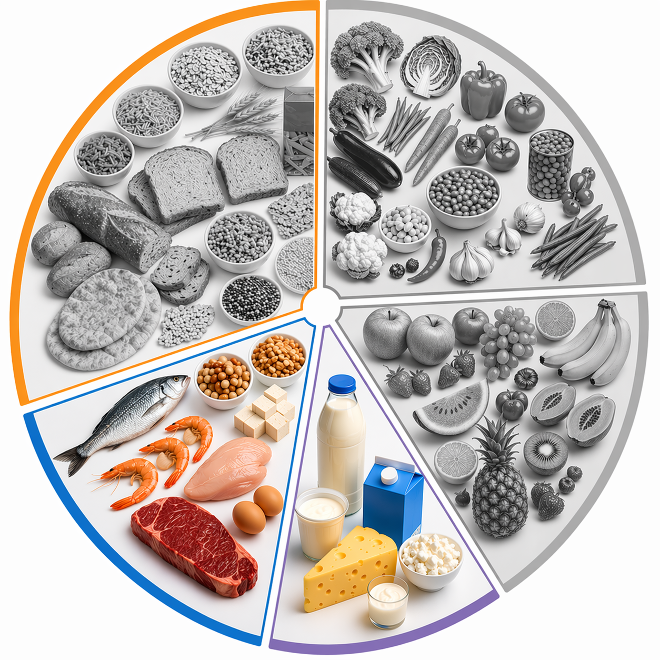
Source: Australian Guide to Healthy Eating
The absence of plant foods is not a minor detail. Fruits, vegetables, legumes, wholegrains, nuts and seeds contribute nutrients and dietary diversity that are consistently associated with long term health benefits. Cutting them out entirely may make a diet easier to define, but it also makes it harder to defend as a balanced long term strategy.
Not all men and women respond in the same way to restrictive diets. Nutritional needs can vary based on age, hormones, reproductive health, activity levels, iron status and bone health.
For women, a very restrictive eating pattern may deserve extra caution where menstrual health, fertility, pregnancy, iron intake, calcium intake and long term bone health are relevant. As registered nutritionist Clémence Cleave notes, many claims linking the carnivore diet to women’s health rely more on personal testimonials than strong evidence, which can give a distorted view of its potential benefits.
For men, the appeal of the carnivore diet is often packaged differently. Online messaging frequently links it to muscle gain, performance, strength, testosterone and biohacking culture. But marketing language does not mean the diet is automatically better suited to male physiology.
As noted by News-Medical, restrictive diets create trade-offs for everyone. The sales pitch may differ, but the potential nutritional limitations still apply.
Sustainability is about more than whether someone can follow a set of food rules for a few weeks. It is about whether a way of eating fits into normal life over time.
Socially, the carnivore diet can make shared meals, family life, celebrations and dining out harder to navigate because it removes so many common foods. That level of restriction may be manageable for some, but isolating for others.
Economically, it can also be expensive. If someone believes they need large amounts of premium meat, grass-fed products or specialty cuts to follow the diet properly, costs can rise quickly.
Environmental and ethical concerns are another consideration. As PETA and News-Medical note, an animal-only eating pattern raises wider questions around greenhouse gas emissions, land use, water consumption and the practicality of promoting this way of eating at scale.
Even if someone can tolerate the restrictions physically, that does not always make the diet realistic socially, financially or environmentally in the long term.
The main takeaway isn’t that everyone interested in the carnivore diet is wrong - it’s that balance is usually more sustainable than dietary extremes.
The carnivore diet may produce short term changes for some people, but that does not automatically make it the best or healthiest long term solution. Many of the outcomes people praise may be linked to eating fewer processed foods, consuming fewer calories overall and paying more attention to habits, rather than to eliminating every plant food forever.
A more flexible, balanced approach is often easier to maintain and better aligned with long term wellbeing. Wellness does not need to come wrapped in shock-value rules or clickbait certainty. In most cases, eating patterns that are more varied, more realistic and easier to live with are the ones that last.
At HIF, the focus is on helping people make informed, balanced health decisions rather than chasing trend-driven extremes. That means supporting choices that are realistic, evidence-aware and easier to sustain over time.
If you are trying to improve your health, small and consistent changes often matter more than dramatic overhauls. Exploring practical information on nutrition, movement and lifestyle habits can be a far more useful starting point than following rigid rules copied from social media.
You can find more evidence-informed guidance across HIF’s Healthy Lifestyle hub, browse more articles in Nutrition, or explore programs such as Healthy Weight for Life for additional support.
Readers looking for practical weight-loss advice can also explore HIF articles on non-diet weight loss, how to lose weight without exercise, and small dietary changes for big results. These resources reflect a more balanced and sustainable approach to weight management than highly restrictive diets.
What is the carnivore diet?
The carnivore diet is a way of eating based almost entirely on animal foods such as meat, fish, eggs and sometimes dairy, while excluding most or all plant foods.
Is the carnivore diet healthy?
The carnivore may lead to short term changes for some people, but many health experts remain cautious about how restrictive it is.
Because the diet cuts out all plant foods, concerns often centre on its lack of fibre, reduced dietary variety and the risk of missing nutrients such as vitamin C and folate over time. As noted by Deakin University, most of the claimed benefits are still largely anecdotal, while the long term risks of such a limited eating pattern are harder to ignore.
Can the carnivore diet help with weight loss?
Some people do lose weight in the short term, but this is often linked to eating fewer calories overall and cutting out many processed foods, not necessarily because the diet is superior in the long term. For some, the weight may return once the diet becomes difficult to maintain over time.
What is the difference between the carnivore diet and paleo?
The carnivore diet is far more restrictive than paleo. A carnivore diet is based almost entirely on animal foods such as meat, fish, eggs and sometimes dairy, while excluding plant foods altogether. Paleo is broader and allows a wider range of whole foods, including fruit, vegetables, nuts, seeds and other minimally processed foods, making it a more varied approach overall.
Are there any carnivore diet benefits?
Some people report reduced cravings, simpler eating, fewer ultra processed foods, easier meal decisions and short term symptom relief, but more research is needed and anecdotal benefits should be interpreted carefully.
Is the carnivore diet harder for women than men?
Not necessarily, but there are different considerations. For women, the diet may provide plenty of iron, which can be relevant during the reproductive years when iron needs are higher. However, that does not mean it is automatically better for women, because for women: highly restrictive eating can make it harder to achieve overall balance, variety and long-term nutrient adequacy, especially where reproductive health, calcium intake and bone health are concerned. For men, the diet is often marketed around muscle, performance and testosterone, but the same core issue remains for both sexes: cutting out major food groups may simplify eating, while also making a healthy diet harder to balance over time.
Is the carnivore diet expensive?
It can be. Relying heavily on animal foods, especially quality cuts of meat, may cost more than a more varied eating pattern. In Australia, official ABS inflation data has shown meat prices rising dramatically in recent periods. That means a diet built so heavily around meat can become expensive quickly, especially if someone feels they need premium cuts or large quantities to follow it properly.
Is the carnivore diet sustainable long term?
For many people, the social, nutritional, financial and environmental realities make it difficult to sustain over time. Long term restriction can also make it harder to maintain dietary variety and may increase the risk of missing key nutrients, while the complete lack of fibre is another major challenge for gut and overall health.